My Brown Capstone: High School Writing Assignments in the Age of AI
A look at the Critical Challenge Project behind the Assignment Design System - what 358 students taught us about AI use, and the three prototypes that came out of it.
This past fall I completed my Critical Challenge Project for Brown University's Master's in Technology Leadership program. The project asked a question that had been nagging me since I started leading academic technology at a boarding school: with AI available to every student, how can teachers be sure that writing assignments still measure real learning?
The answer turned out to be less about the technology and more about assignment design.
The research
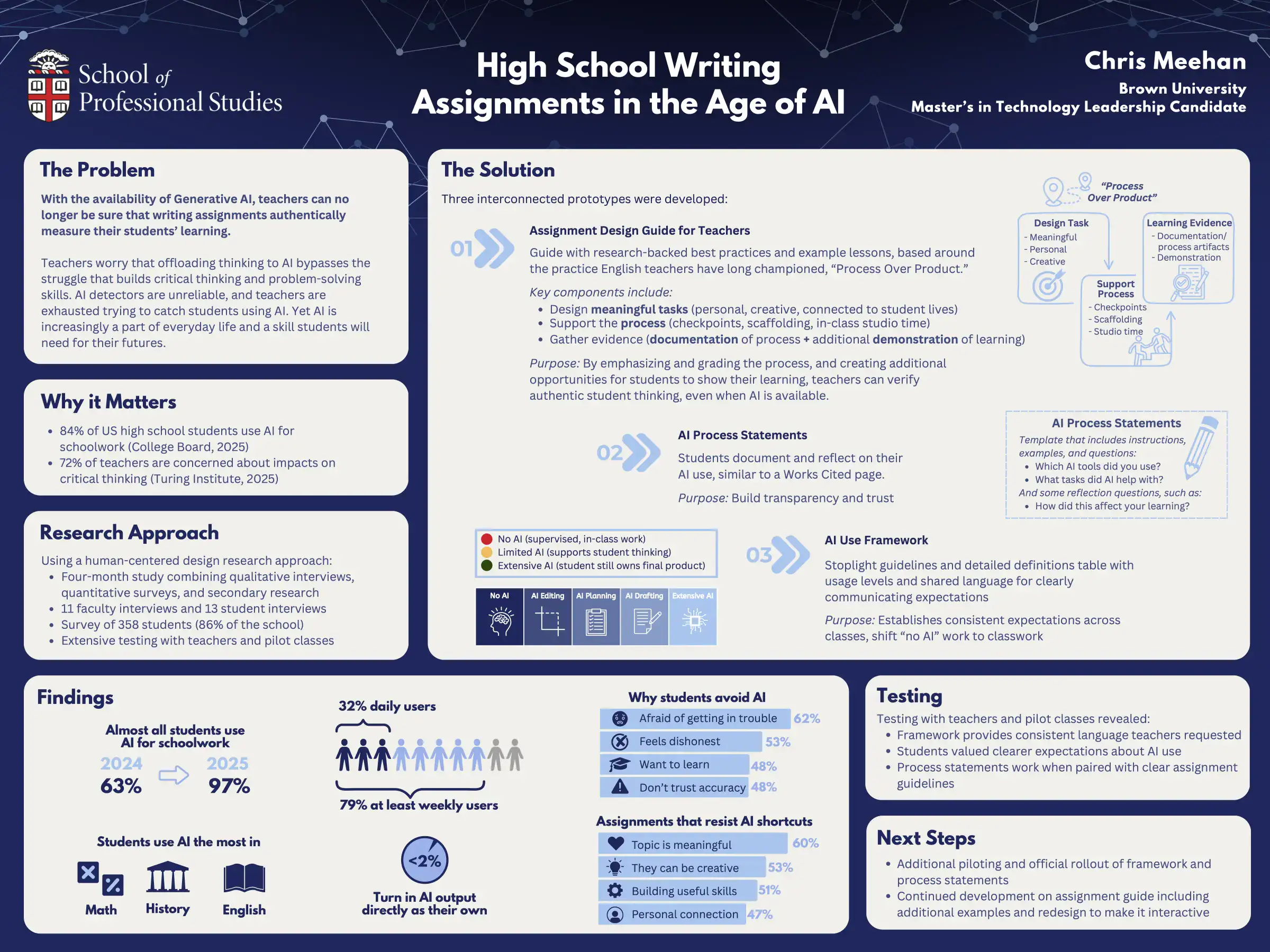
Using a human-centered design approach, I ran a four-month study combining qualitative interviews, a large-scale survey, and secondary research:
- 11 faculty interviews exploring how teachers think about AI in their classrooms
- 13 student interviews digging into actual AI use patterns and decision-making
- A survey of 358 students (86% of the school) capturing usage frequency, motivations, and attitudes
- Extensive testing with teachers and pilot classes
The findings challenged some assumptions. AI use at the school jumped from 63% to 97% in just 18 months. But less than 2% of students reported turning in AI output directly as their own work. Most use fell on a spectrum — brainstorming, editing, research support, concept clarification — that looked nothing like the "students are cheating" narrative.
What students told us
The data revealed patterns that matter for assignment design:
Why students avoid AI had little to do with learning values. 62% cited fear of getting in trouble as the top deterrent. Only 48% said they wanted to learn. That's a compliance culture, not a learning culture — and it's fragile.
What makes assignments resistant to AI shortcuts pointed toward design, not policy. Students were least likely to use AI when a topic was personally meaningful (60%), when they could be creative (53%), when they were building useful skills (51%), or when there was a personal connection (47%).
Where students use AI most — math, history, and English — tracked closely with subjects where assignments tend to ask for information retrieval or polished output rather than visible thinking.
The through-line: the problem isn't students. It's assignments that don't require enough visible thinking in the first place.
The three prototypes
The research produced three interconnected tools, which became the Assignment Design System:
1. Assignment Design Guide. Research-backed strategies organized around the practice English teachers have long championed: "process over product." Design meaningful tasks, support the process with checkpoints and scaffolding, and gather evidence through both documentation and demonstration.
2. AI Process Statements. A template where students document and reflect on their AI use — which tools, for what tasks, at what stage — similar to a Works Cited page. Graded on honesty and specificity, not on whether AI was used.
3. AI Use Framework. A stoplight system (red/yellow/green) with detailed definitions across five usage levels, giving teachers and students shared language for expectations. The key shift: move "no AI" work into supervised class time rather than trying to enforce it at home.
What testing revealed
Piloting the prototypes with teachers and classes confirmed several things:
- The stoplight framework provided the consistent language teachers had been requesting
- Students valued clearer expectations about what AI use actually looked like in practice
- Process statements worked best when paired with clear assignment guidelines — without the design guide, they felt like busywork
What's next
The prototypes are live on this site as the Assignment Design System, with the full guide, templates, and implementation checklist available for download. I'm continuing to pilot the framework and develop the assignment guide into something more interactive.
If you're working on similar problems at your school, I'd welcome the conversation — reach out directly.
Signature framework
The Assignment Design System
See the full assignment design system that connects the ideas in this article to classroom practice.
Resource engine
Move from reading to action
Use the readiness quiz, lesson analyzer, policy builder, and assignment library to put the ideas into practice.

Chris Meehan
I lead academic technology at a leading independent school and recently finished my master’s at Brown, researching AI in grades 9-12. I publish frameworks, tools, and articles for secondary-school educators.